Category: Misc
Scroll to read our article
Forging the Future: Saudi Arabia's New Generation of Talent
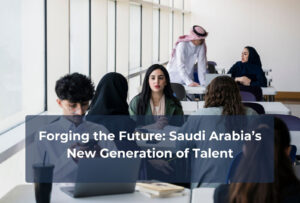
At the 2025 TOURISE Summit in Riyadh, a landmark partnership between Saudi Arabia and Switzerland was announced through the agreement between Tanmeya Capital and Sommet Education, confirming the Kingdom’s ambition to align its youth training ecosystem with the highest international standards. Backed by an investment of SAR 600 million, equivalent to approximately 140 million euros, the initiative aims to build a world class education platform in tourism, hospitality and culinary arts while embedding Swiss excellence at the heart of Saudi human capital development. This strategic cooperation illustrates in concrete terms how Vision 2030 is being translated into workforce reforms designed to prepare a new generation for global competitiveness. At the heart of this transformation, Saudi Arabia is reshaping its economic model towards diversification, innovation, productivity and human capital. In this context, youth represents a strategic asset, with nearly 70 per cent of Saudi citizens under the age of 35, making the Kingdom one of the youngest countries in the Middle East and providing a unique reservoir of talent, social dynamism and labour capacity to sustain this historic shift.
As Crown Prince Mohammed bin Salman has emphasised, “The future of Saudi Arabia is not dependent on oil, but on the minds of our people and their ability to unleash their potential.” This perspective places human development above natural resources, knowledge above economic considerations and creativity above extraction. The Misk Foundation plays a central role in this vision. It has become one of the Kingdom’s most influential engines for youth empowerment by offering scholarships, leadership programmes, entrepreneurship incubators and international fellowships that help nurture a generation of innovative, globally minded leaders capable of shaping the country’s future.
To unlock this potential, Saudi Arabia is investing comprehensively in the education of its young population, from early schooling through to higher graduation. The country is modernising its universities, expanding executive training opportunities and strengthening technical and vocational pathways. These efforts are closely supported by the National Transformation Program, which seeks to improve institutional performance, develop talent capacities and enhance national competitiveness. The Kingdom is also working with international, particularly European, partners to bring in specialised expertise, advanced educational methodologies and global perspectives that will enable Saudi youth to operate confidently and competitively on the world stage.
Saudi youth therefore stands at the centre of national transformation and is becoming one of the principal drivers of future growth. Ensuring that this generation receives the education, empowerment and training it needs is essential for shaping the Saudi Arabia of tomorrow, a country that aspires to be more competitive, more open and more sustainable.
Saudi youth therefore stands at the centre of national transformation and is becoming one of the principal drivers of future growth. Ensuring that this generation receives the education, empowerment and training it needs is essential for shaping the Saudi Arabia of tomorrow, a country that aspires to be more competitive, more open and more sustainable.
Higher Education and Research
In 2024, almost 2 million students were enrolled in higher education across 62 universities in Saudi Arabia. Based on the Anglo-Saxon model, the system allows graduates to enter a preparatory programme or directly begin university. In the Kingdom, a Bachelor’s degree typically takes four years, Master’s one year, and Doctorate’s three to five years.
Saudi Arabia now aims to position itself as a preferred destination for international students. To this end, the Kingdom launched the national platform Study in Saudi Arabia, which facilitates university admissions and simplifies visa procedures for foreign students. Supported by the Vision 2030 agenda and significant investments in the higher education sector, Saudi Arabia is enhancing both the quality of academic offerings and the reception, integration, and support services dedicated to international students. From an academic perspective, the Kingdom is gaining visibility in global rankings: over 20 universities appear in the QS Rankings 2026; 13 universities are listed in the Shanghai Ranking 2025.
Scientific research has become a cornerstone of Saudi Arabia’s national transformation, underpinning Vision 2030 and the shift towards a knowledge-based, innovation-driven economy. Through leading institutions such as KACST and the rapid development of Saudi universities, the Kingdom is building strong research capabilities while equipping its youth with advanced skills. Scholarships, international partnerships and specialised training programmes all contribute to this momentum, making research a key driver of youth empowerment and the country’s modernisation.
Saudi Arabia is deepening its engagement with international expertise in higher education and research, notably through a wide range of ministerial scholarship programmes that support young Saudis studying abroad in key fields such as AI, data science, engineering, medicine, specialised healthcare and scientific research. Complementing this outward-looking strategy, the Kingdom has also launched Riyadh University of Arts, a flagship initiative designed to position Saudi Arabia as a regional centre for cultural and creative education. The university aims to train the next generation of talent in visual arts, design, performing arts and cultural management, reflecting the country’s ambition to equip its youth for the rapidly growing culture and entertainment industries. Together, these efforts illustrate the Kingdom’s determination to build a highly skilled generation capable of driving its transformation across both strategic scientific fields and the broader cultural and creative ecosystem.
Vocational Education
As Saudi Arabia advances its broad economic diversification under Vision 2030, the rapid expansion of the tourism sector has emerged as a key driver of this national transformation. The country’s strategy to attract 150 million visitors by the end of the decade is already creating a strong and growing demand for skilled workers across the Kingdom. This need is particularly evident in tourism professions and the many services that support them. To meet this challenge, the Ministry of Tourism has launched the Tourism Trailblazers Programme, which aims to train a new generation of “tourism pioneers” and provide young Saudis with international-level skills. The programme is delivered in collaboration with leading European institutions, including the University of Surrey, Ferrières Hospitality & Luxury Management School and Les Roches in Switzerland, all renowned for their excellence in hospitality, tourism and luxury service education. This ambitious investment in human capital reflects the Kingdom’s determination to build a highly competitive national workforce capable of sustaining the long-term growth of its tourism industry.
The Technical and Vocational Training Corporation (TVTC), which operates under the Ministry of Education, plays a central role in equipping young Saudis with practical skills that match the needs of a rapidly evolving labour market. Its mission is to provide high-quality training across a wide network of technical colleges and vocational institutes, ensuring that students acquire competencies aligned with the country’s economic priorities. TVTC also oversees the accreditation of private training providers, ensuring that professional qualifications issued within the Kingdom meet rigorous standards of relevance and excellence. By bridging the gap between education and employment, the institution helps develop a technically proficient workforce capable of supporting growth in both established industries and emerging sectors.
These efforts form part of a broader landscape of national initiatives that collectively aim to meet the country’s growing labour market needs.
As Saudi Arabia advances its broad economic diversification under Vision 2030, the rapid expansion of the tourism sector has emerged as a key driver of this national transformation. The country’s strategy to attract 150 million visitors by the end of the decade is already creating a strong and growing demand for skilled workers across the Kingdom. This need is particularly evident in tourism professions and the many services that support them. To meet this challenge, the Ministry of Tourism has launched the Tourism Trailblazers Programme, which aims to train a new generation of “tourism pioneers” and provide young Saudis with international-level skills. The programme is delivered in collaboration with leading European institutions, including the University of Surrey, Ferrières Hospitality & Luxury Management School and Les Roches in Switzerland, all renowned for their excellence in hospitality, tourism and luxury service education. This ambitious investment in human capital reflects the Kingdom’s determination to build a highly competitive national workforce capable of sustaining the long-term growth of its tourism industry.
Executive Programs
To meet the evolving demands of the labour market and support the ambitions of Vision 2030, Saudi Arabia has significantly expanded its landscape of executive education, drawing on both national institutions and leading international schools to train the country’s future leaders. A growing number of Saudi organisations now rely on high-level executive programmes to prepare senior managers, entrepreneurs, public-sector executives and project leaders driving the Kingdom’s transformation. Nationally, universities such as KFUPM, MBSC, and Alfaisal University offer robust executive education programmes focused on leadership, management, innovation and entrepreneurship, all aligned with the country’s strategic priorities. In parallel, the Kingdom has developed fruitful partnerships with several major European institutions, including INSEAD, HEC Paris, Business School Netherlands, and London Business School. The latter has strengthened its presence in the Kingdom by opening an Executive Education office in Riyadh at Diriyah, offering both open-enrolment and customised programmes, and underscoring its commitment to supporting Saudi Arabia’s human capital development. Together, these initiatives reflect a strategic effort to cultivate a new generation of decision-makers capable of driving the Kingdom’s economic diversification and institutional modernisation.
As Saudi Arabia accelerates its national transformation, the education and empowerment of its youth stand at the core of its future ambitions. The Kingdom’s substantial investment in higher education, technical training and executive development is complemented by far-reaching scholarship schemes, including the Scholarships of the Two Holy Mosques, which encourage young Saudis to pursue advanced studies in strategic fields both domestically and abroad. This outward-looking strategy is further strengthened through growing cooperation with Europe via programmes such as Erasmus+, notably through its International Credit Mobility track, which enables academic exchanges between Saudi and European universities. These mobilities contribute directly to the internationalisation of Saudi higher education, the circulation of knowledge and the training of a new generation of globally connected leaders.
At the same time, Saudi Arabia is steadily establishing itself as a regional educational hub. Leading international institutions such as IE University, the University of Strathclyde and the Royal College of Surgeons in Ireland have already opened branches in the capital, drawn by the dynamism of the Saudi education sector and the Kingdom’s clear aspiration to become a centre for innovation, research and cultural development in the Middle East.
Saudi Arabia is also placing increasing emphasis on employability. Major student fairs, sector-specific career forums and national initiatives such as the Human Capability Initiative are creating stronger connections between education, labour-market needs and professional opportunities for young Saudis. This integrated approach ensures that the skills developed across universities, technical institutes and executive programmes align with the demands of fast-growing sectors including engineering, tourism, culture, healthcare and the digital economy.
In this context, the Kingdom offers expanding opportunities for European schools and universities that wish to establish a presence in Saudi Arabia or forge strategic partnerships. The openness of the sector, the strong demand for international expertise and the central role assigned to education within Vision 2030 create a favourable environment for long-term collaboration.
By placing its youth at the heart of its transformation, Saudi Arabia is laying the foundations of an economy built on talent, knowledge and innovation. A new generation, better trained and more globally connected than ever before, is poised to shape the Kingdom of tomorrow.

© 2025 – European Chamber of Commerce in the Kingdom of Saudi Arabia (ECCKSA) – All rights reserved.
License: 108194507255955

This website is proudly hosted in Europe and built by
